Featured Photograph
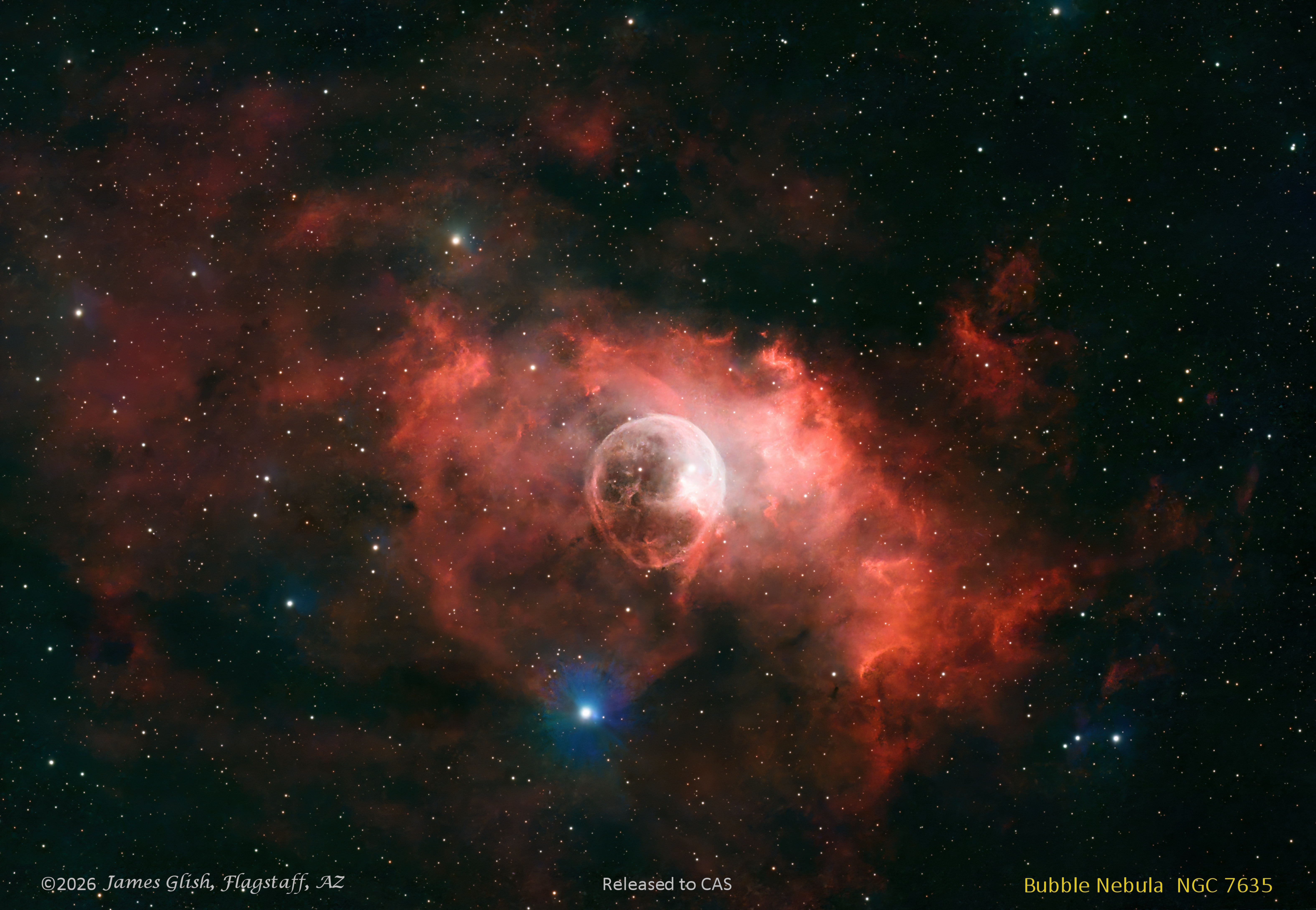
Bubble Nebula
© 2026 Jim Glish
The Bubble Nebula (NGC 7635) has always been one of my favorites. This image was taken with a Celestron Edge HD-8 at f/10 using an ASI-294MC color camera with an IDAS-LPS4 dual-band filter. It is the result of about 60, 3-minute, stacked images, for a total exposure time of 3 hours, which were then processed with PixInsight.
NGC7635 is located in the constellation Cassiopeia and is an emission nebula with a distinctive "bubble" that is nearly 7 light-years wide resulting from the glowing stellar wind of the massive, hot, young O-type star near its center. The stellar wind causes a shock wave that is expanding at about 4 million miles per hour, sweeping up and heating gases and dust along the way, making the 40,000 year old bubble a relatively recent creation. At approximately 7,100 light-years from Earth, this object benefits from a long exposure to bring out details and subtle pink to red color differences of the different temperatures of ionized gases, including hydrogen, nitrogen, and oxygen.
Jim Glish
The featured photograph is any astronomical photograph provided by one of our members. If you are a member and have a photograph you would like to submit, please refer to the Featured Photo Guidelines for more information. The submission deadline is the 15th of each month.
Saturday, October 17, 2026 (Moved from October 24th)
Presenter: William Sheehan
Title: Roaming the Dark Skies of a World Lit Only by Fire: Astronomical Glimpses from the Upper Paleolithic
Description: This will be effectively the way that members of our species who painted the caves of the Upper Paleolithic, including the Pleiades on the ceiling in the Hall of the Aurochs at Lascaux, viewed the astronomical objects of their world. I hope to invoke a bit given my background in neuroscience the likelihood that they were wired rather differently from us, and had a very different experience of the world around them, which we could hardly imagine. I would like for this to be attended not only by CAS members but also warmly invite members of the Flagstaff Dark Skies Coalition to what I hope will be a pleasant evening of telling tales around the campfire.
Bio: William Sheehan is a retired psychiatrist, astronomy historian and author, and amateur astronomer. He has written 30 books including, most recently, "Solar Eclipses," "The Solar System" (with Cliff Cunningham), "Parallel Lives of Astronomers: Percival Lowell and Edward Emerson Barnard," "Space Age Generation" (with Klaus Brasch), "Discovering Mars" (with Jim Bell), "Discovering Pluto" (with Dale P. Cruikshank"), "Northern Arizona Space Training" (with Kevin Schindler), etc., etc. He is a long-time contributor to Sky and Telescope and the Biographical Encyclopedia of Astronomers, and has contributed a chapter to Astronomy and Philosophy: Conceptual and Methodological Foundations and Challenges (Cambridge U Press, 2026).
CAS Monthly Meetings and Astronomical Programs are held the
Saturday closest to the Full Moon at the Mars Hill Campus of
Lowell Observatory, Hendricks Center for Planetary Studies
Auditorium (6:45 pm - 8:00 pm), unless otherwise noted followed
by refreshments, and informal discussion. Meetings are open and free
to the public.