A relative newcomer to astronomy, Jim began viewing and shooting the stars soon after moving to Flagstaff in 2014. He started out in a house surrounded by tall Ponderosa Pines with a portable tripod-based telescope that had to be used at a remote location and soon realized that he needed a more permanent solution. So, in 2020, he moved to Fort Valley, in the shadow of the San Francisco Peaks, and set out to build an observatory in his front yard.
|
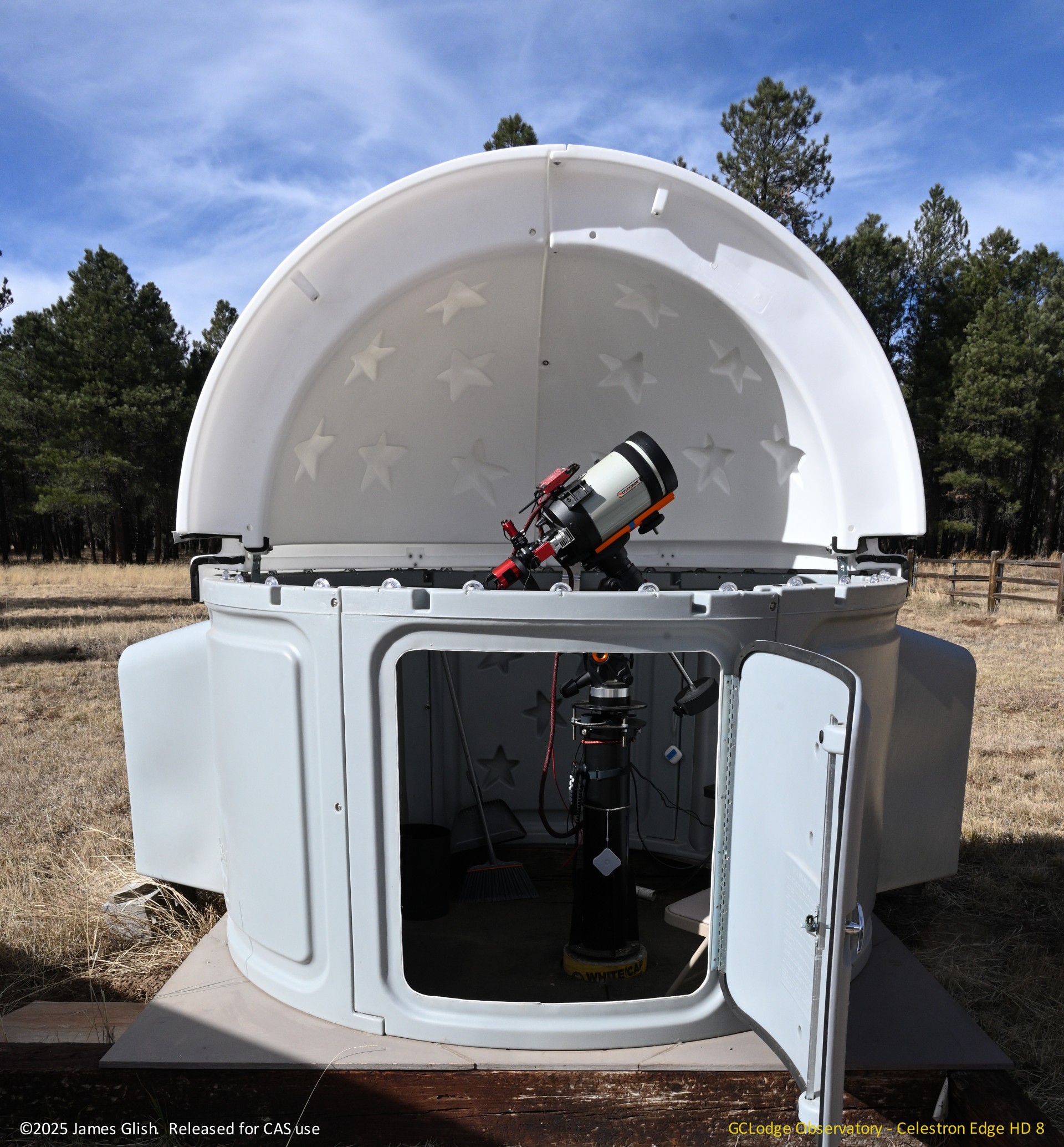
GCLodge Observatory |
Most images here were taken using a Celestron Edge HD 8 inch SCT reflector telescope with either a native focal length of 2100mm (f10) or a reducer length of 1440mm (f7) on a Celestron CGEM mount affixed to an 8 inch steel pier housed in a SkyShed POD dome observatory. Images are captured at the scope with a ZWO ASIAir Plus controller using a primary ZWO 294MC Pro cooled color camera and a ZWO 174MM mono guide camera attached to a Celestron Off-Axis Guider. Other gear includes a ZWO Electronic Auto Focuser, ZWO Electronic Filter Wheel, and a dew shield and heater. Jim Glish |
|
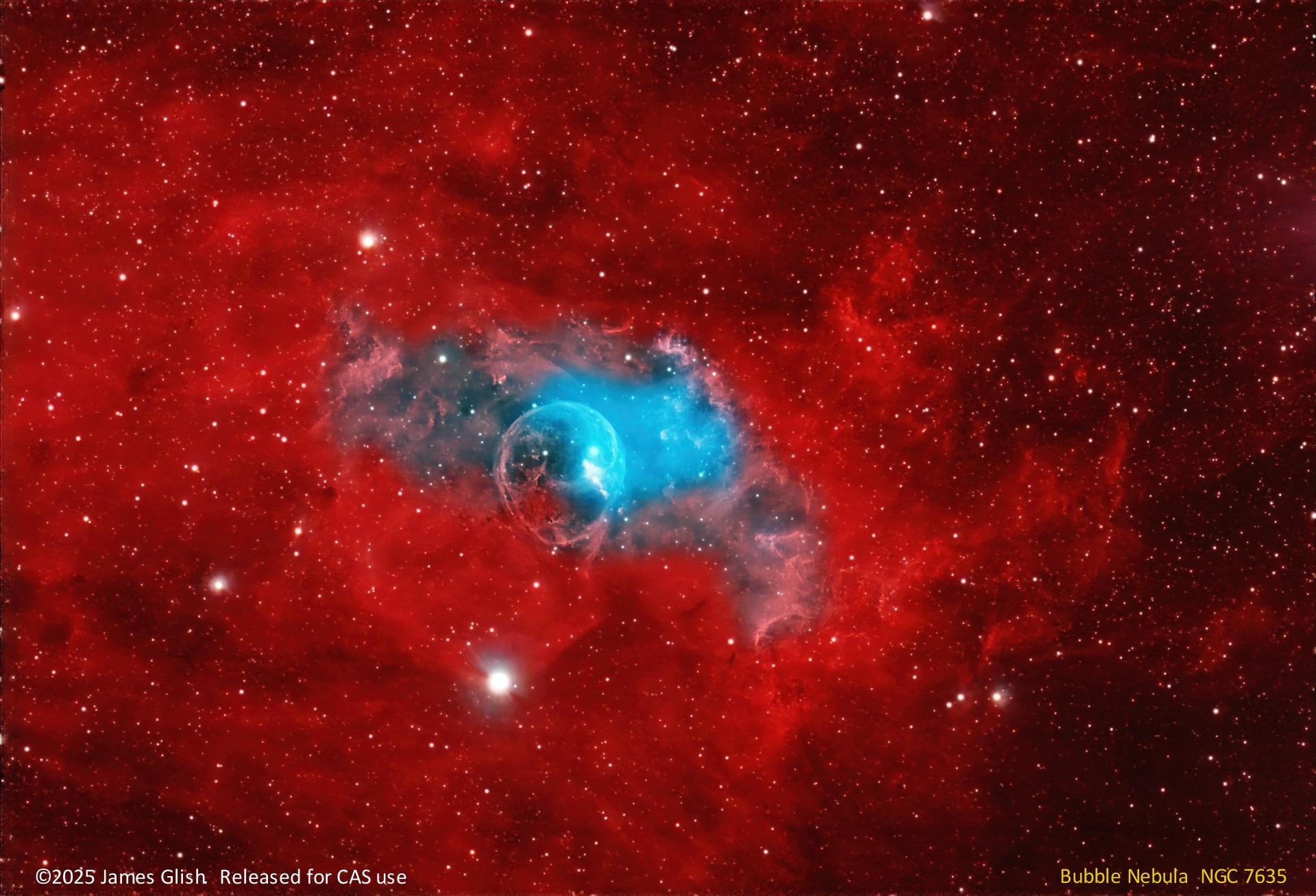
Bubble Nebula (NGC 7635) |
NGC 7635 is an Hii emission nebula in the constellation Cassiopeia. The distinctive “bubble” is almost 7 light-years across and is the result of the stellar wind from a massive, hot, young star near its center causing it to glow. At approximately 7,100 light-years from Earth, this object is quite faint and requires long exposure to bring out details and subtle color differences of the different temperatures of gases, from red and pink for hydrogen and nitrogen to the iridescent blue of glowing oxygen. The image stack consists of 22 x 300s images at f/7 processed in PixInsight with an HSO palette. James Glish |
|
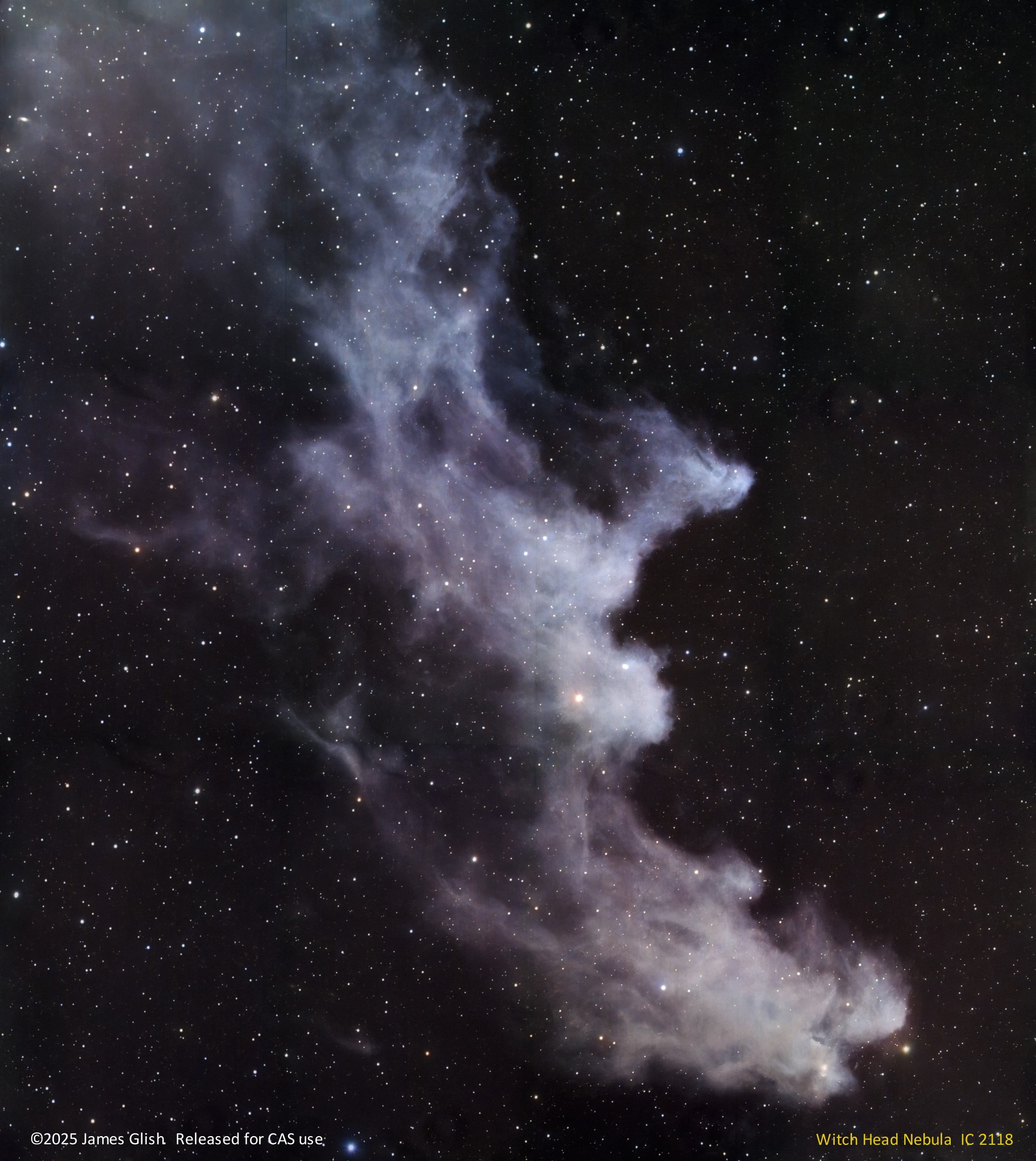
Witch Head Nebula (IC 2118) © 2025 James Glish |
The constellation Orion is home to the extremely faint reflection nebula IC 2118 which is a relative close 900 light-years from Earth. This ancient supernova remnant is a dust and gas cloud illuminated by nearby Rigel and is likely a star forming region. The “witch head” resembles a side profile of a Witch’s face with a long nose and pointy chin. This is a 4x3 panel mosaic with each image panel consisting of 36 x 180s images at f/7. James Glish |
|
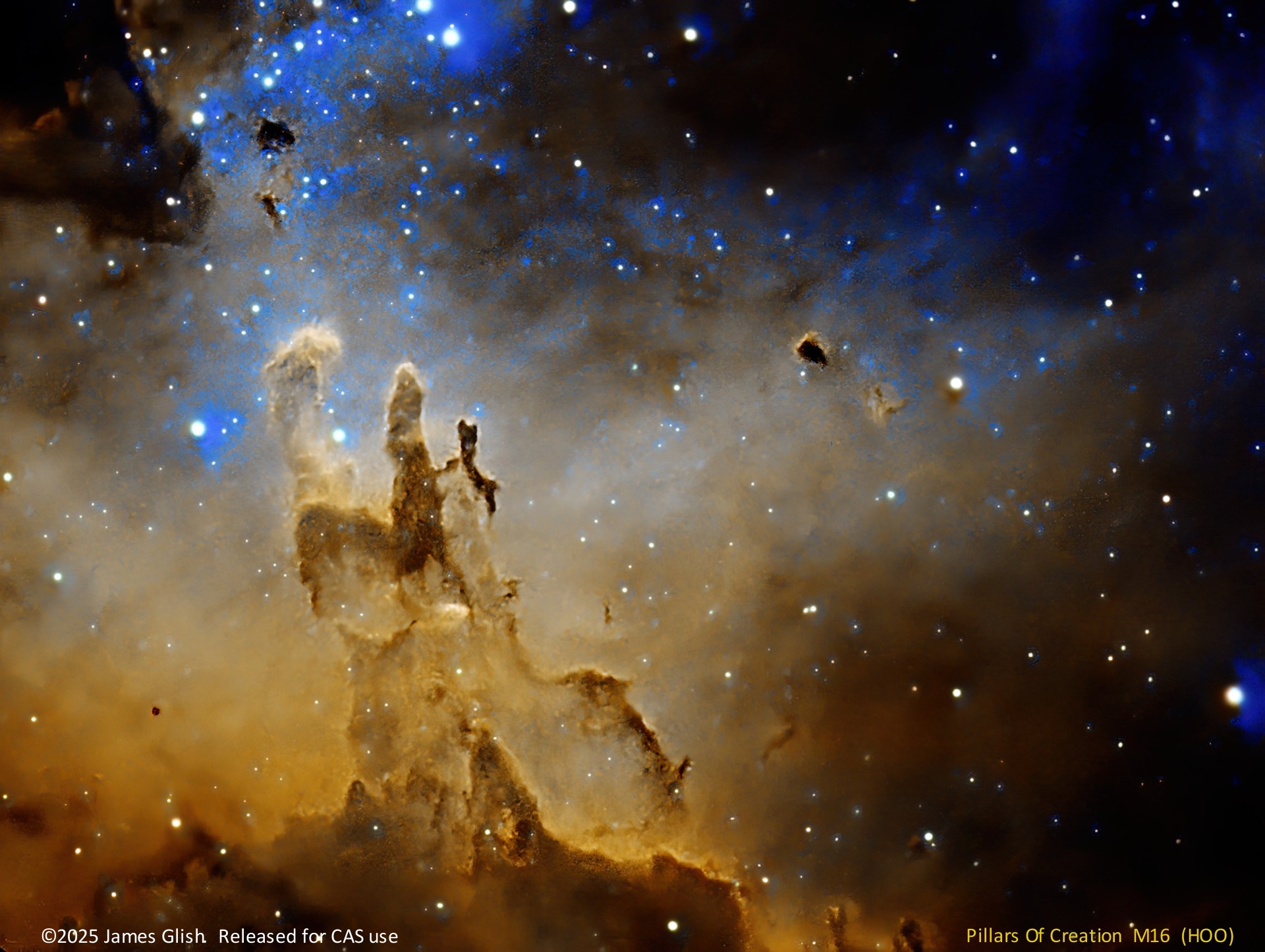
Pillars of Creation (M16) © 2025 James Glish |
The elephant trunks that make up the pillars within the Eagle Nebula (M16) of the Serpens constellation were discovered by John Charles Duncan in 1920 using the Mount Wilson Observatory 60-inch telescope. This massive star forming region of gas and dust some 7,000 light-years from Earth is illuminated by the light from recently formed nearby stars. The object was made popular recently with an image from the Hubble Space Telescope that uses an alternate color palette with green representing hydrogen, red for ionized sulfur, and blue for double-ionized oxygen atoms. Made up of 38x180s images at f/10 using a dual band filter, this modified SHO palette image rendering was my attempt at a ‘Hubble’ treatment. James Glish |
|
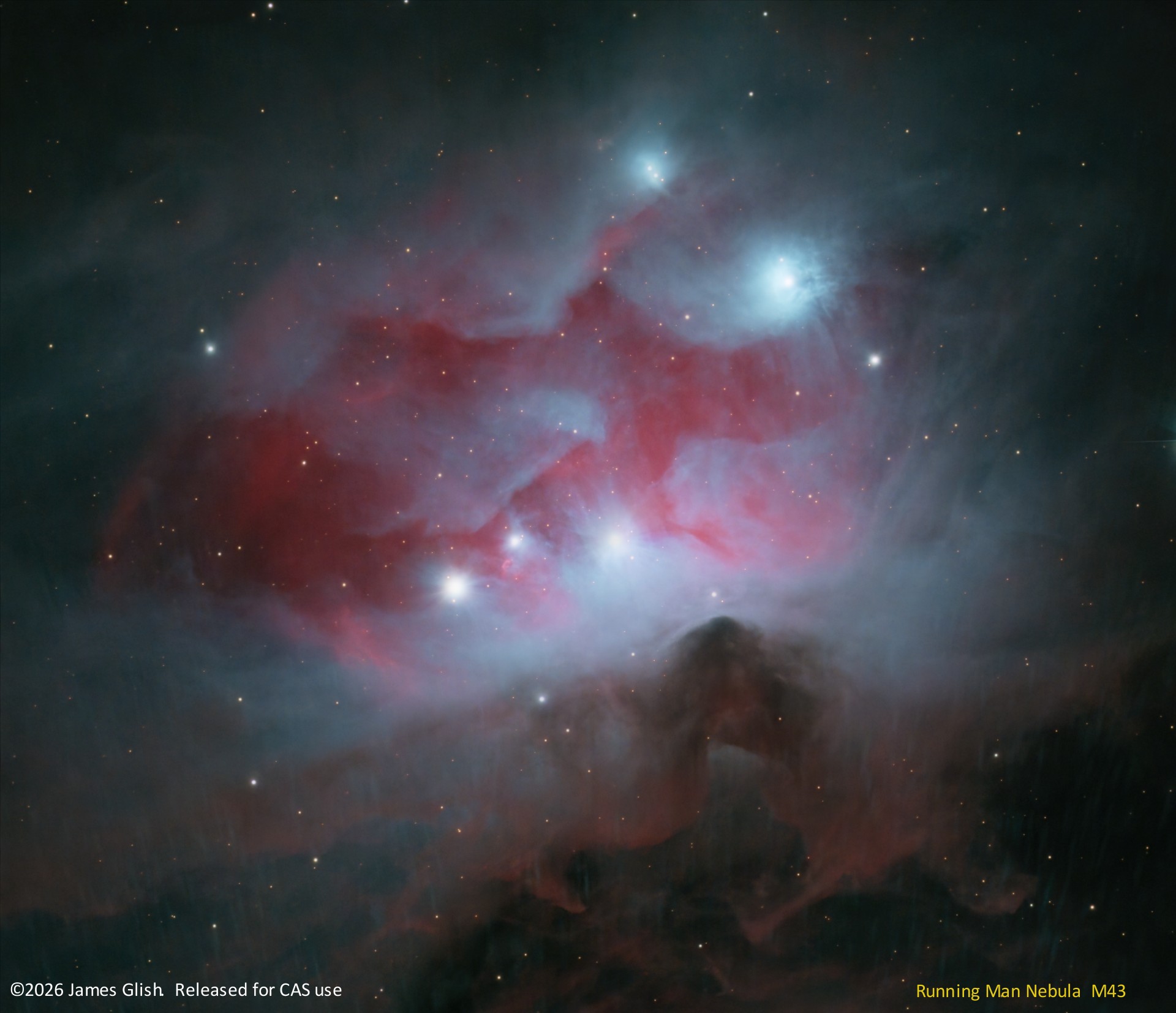
Running Man Nebula (M43) © 2024 James Glish |
The Running Man Nebula, M43, is a reflection nebula in the Orion constellation close to its neighbor M43. Discovered in 1786 by William Herschel, observers see a human figure with his arms appearing to be in motion, like a runner. Although both appear in the same field of view, M43 is much fainter than M42 and is best seen photographically. With 2.5 hours of total exposure at f/10, it uses 24x180s dual band filtered images combined with 24x180s UV/IR images to bring out the subtle pinks and blues. James Glish |
|
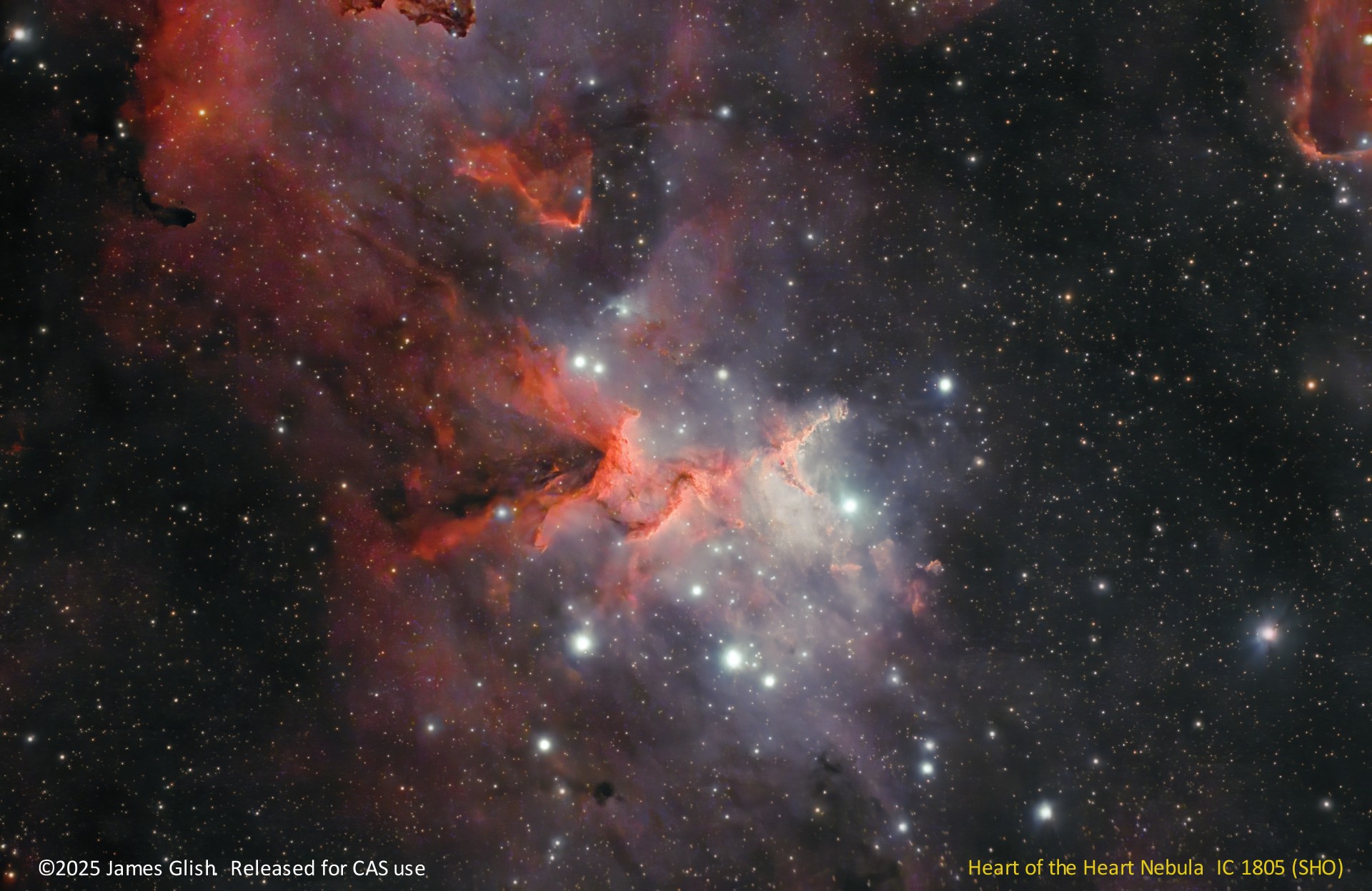
Heart of the Heart Nebula (IC 1805) © 2025 James Glish |
Located in the center of the Heart Nebula (IC 1805), the “Heart of the Heart” is actually the open star cluster Melotte 15 which is a brilliant star forming region. Located some 7,500 light-years from Earth in the constellation Cassiopeia, this rich array of stars and dust is surrounded by the bright red glow of ionized hydrogen and sulfur gases with noticeably darker dust lanes. The total exposure of 4 hours is made up of 55 x 180s dual band filtered images combined with 25 x 180s UV/IR images and processed using an SHO color palette. James Glish |
|
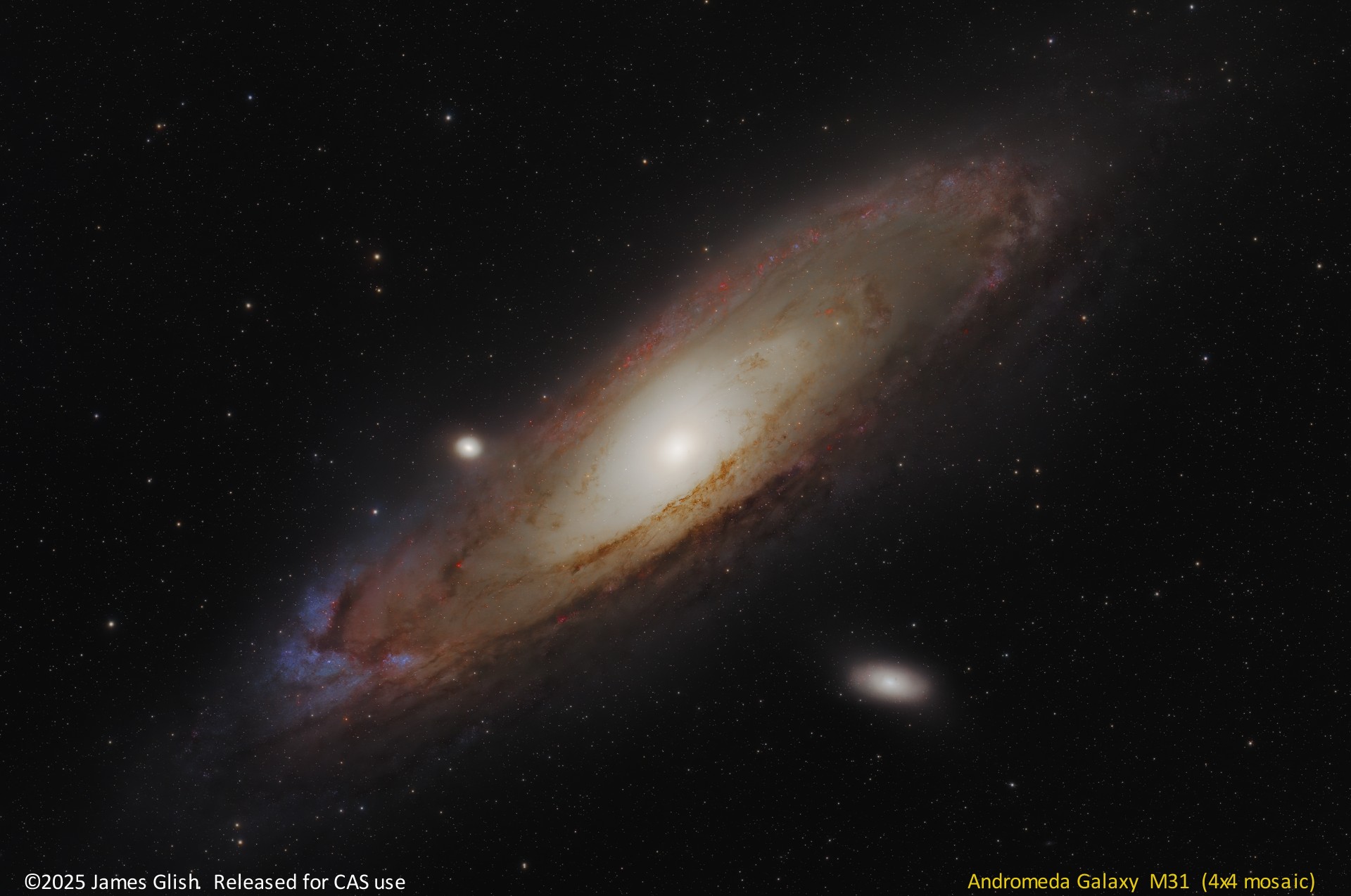
Andromeda Galaxy (M31) © 2025 James Glish |
M31 is the nearest major spiral galaxy to us at about 2.5 million light-years from Earth and is more the twice the size of the Milky Way. This popular object in the Andromeda constellation can often be seen with the naked eye or low power binoculars. However, since the relative size of the Andromeda Galaxy is almost 6 times the width of the moon, this image, taken with a 1440mm Edge HD 8 telescope, is actually a 16 panel mosaic with 4 rows and 4 columns of separate stacked image panels stitched together in post-processing with PixInsight. With each panel representing about 1 hour of light gathering (20 3-minute exposures), the total image gathering time was more than 16 hours over several nights. With so much data, I feel that I was able to capture both the detail and incredible color range of this favorite deep sky object. James Glish |
|
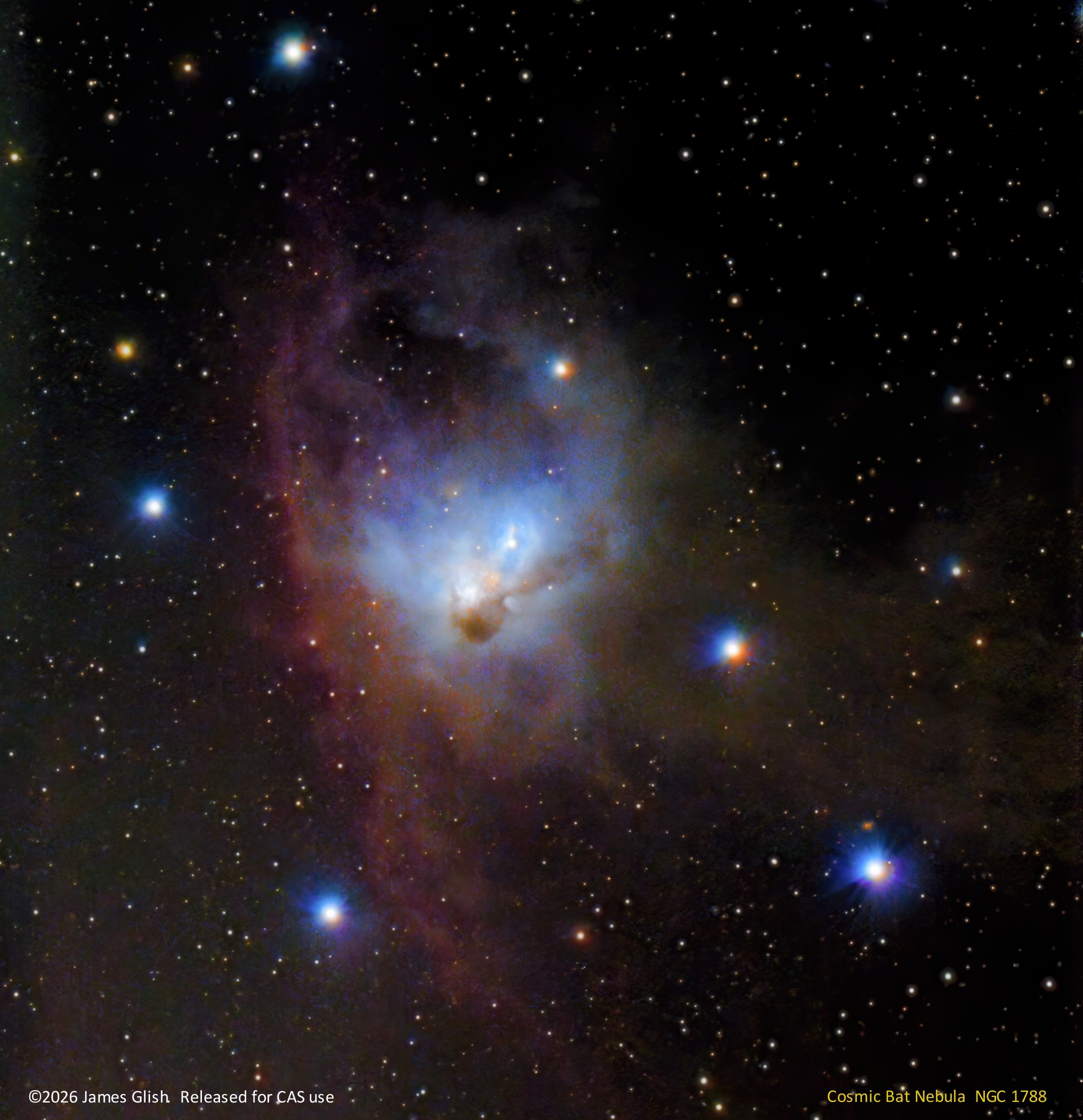
Cosmic Bat Nebula (NGC 1788) © 2026 James Glish |
This interesting reflection nebula in the constellation of Orion is NGC 1788 and was discovered by William Hershel in 1786 as he was cataloging objects near the Orion Nebula. Sometimes called the Bat Nebula or Cosmic Bat Nebula, the ‘bat’ is surrounded by a red ring of glowing hydrogen gas. The inner stars are only about a million years old, making it one of the younger star forming regions. With about 2 hours of total exposure, it consists of 38x180s of unfiltered images. James Glish |
|
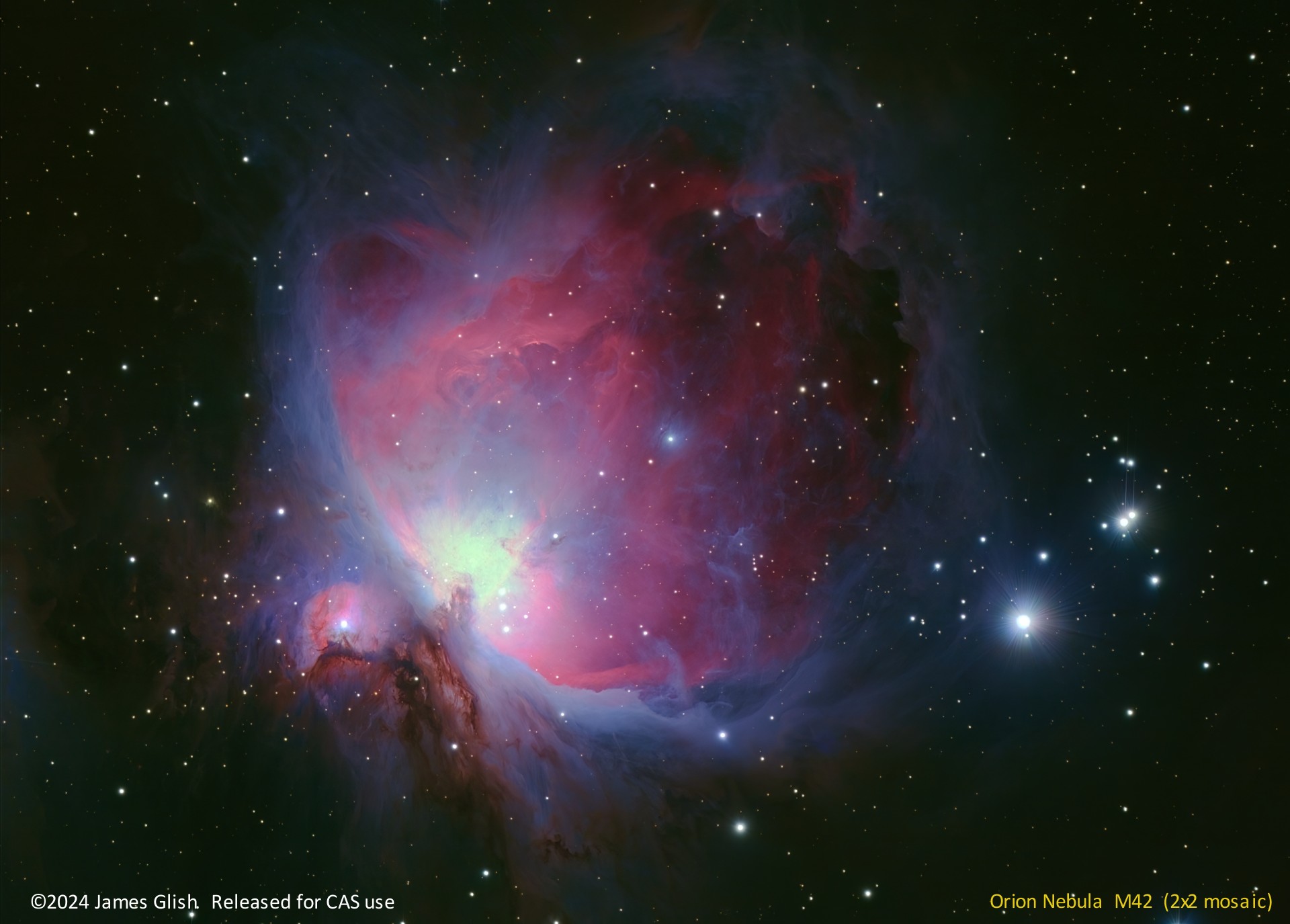
Orion Nebula (M42) © 2024 James Glish |
The Orion Nebula, M42, is a large star forming region that appears as the middle ‘star’ in the sword of the Orion constellation. Visible with the naked eye, this large star forming region consists of glowing red Ha gas emissions and blue-violet light reflected from large groups of young O-class stars. At about 1,340 light-years from Earth, the nebula spans nearly 25 light-years across and is the closest massive star-forming region to us. Due to its intense brightness and a hard to capture core, this image consists of less than an hour of total exposure using about 100 30-second images. James Glish |
|
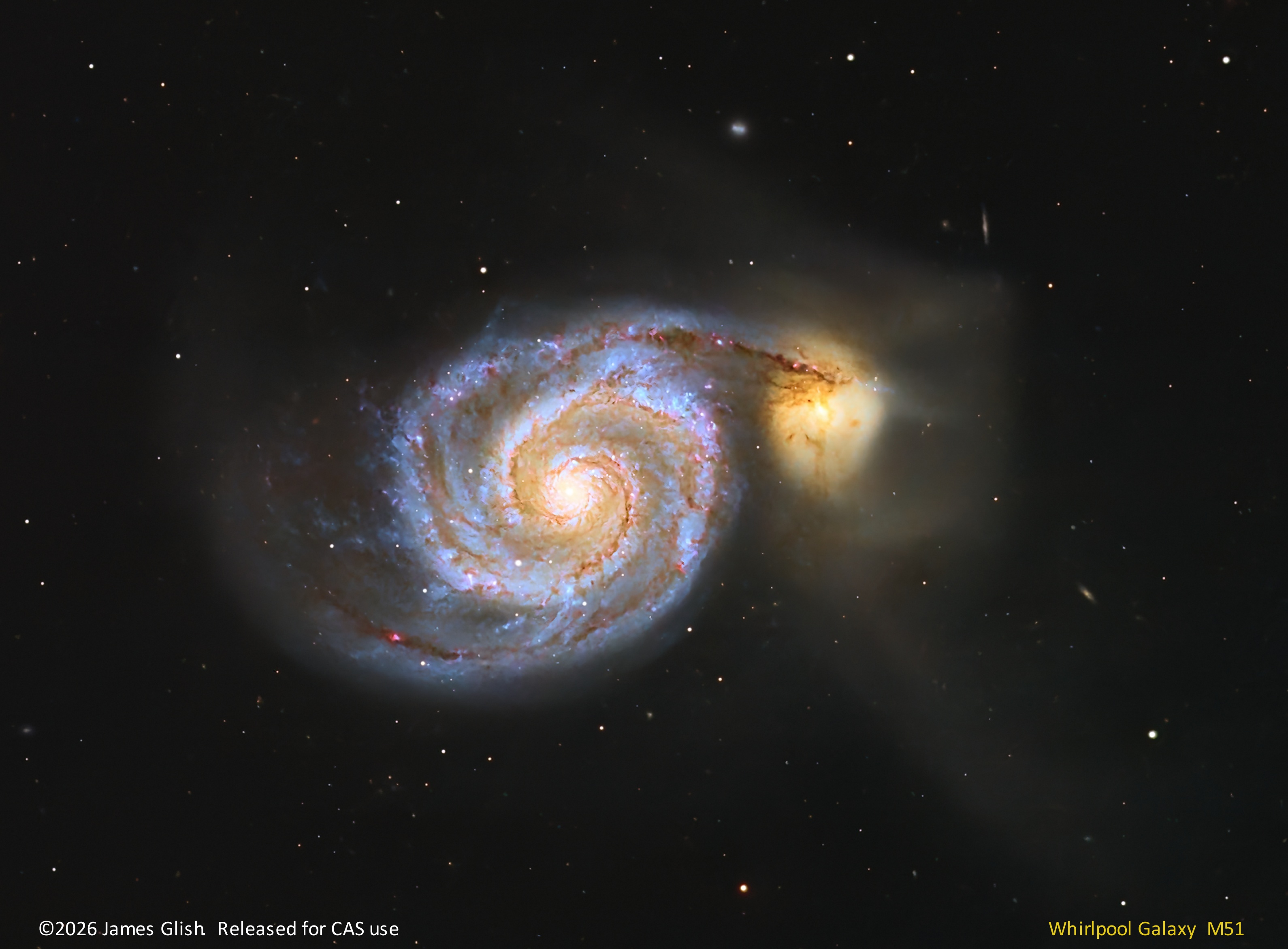
Whirlpool Galaxy (M51) © 2026 James Glish |
The Whirlpool Galaxy (M51) is easily observed by most any telescope looking to the north in our clear, dark Flagstaff sky. M51 itself is an interacting grand spiral galaxy that's paired with its neighbor dwarf galaxy NGC 5195. They are connected by a tidal bridge of dust and gas and both are surrounded by a subtle translucent plume of material extending out from the pair. During post-processing, I've tried to maintain a balance between the contrasting spiral structure details of M51, the brilliant light of NGC 5195, and the ethereal glow of the plume. Captured using a Celestron Edge HD 8 inch SCT telescope at a native focal length of 2100mm (f/10) and an ASI294mc cooled camera (with UV/IR filter) controlled by an ASIAir Plus and ZWO autofocuser. A stacked image consisting of 75 three-minute sub frames (3.75 hours) was processed with Pixinsight and Topaz DeNoise AI. James Glish |