Unless indicated otherwise, all data for the images were acquired using an Astro-Tech AT152EDT Triplet APO with a 1216mm focal length fitted with a Reducer/Field Flattener that results in a f/6.4 speed telescope. A ZWO ASI Air Plus controls a ZWO ASI294MC-P OSC camera, a ZWO EAF Electronic Focuser, a ZWO ASI120MM Mini monochrome camera attached to an ZWO M68 Large Off-Axis Guider, a ZWO 5 Position Electronic Filter Wheel and a dew heater strip. All lights were processed along with calibration frames using PixInsight, denoised with Topaz Photo AI and further processed using Affinity 2.0.
|
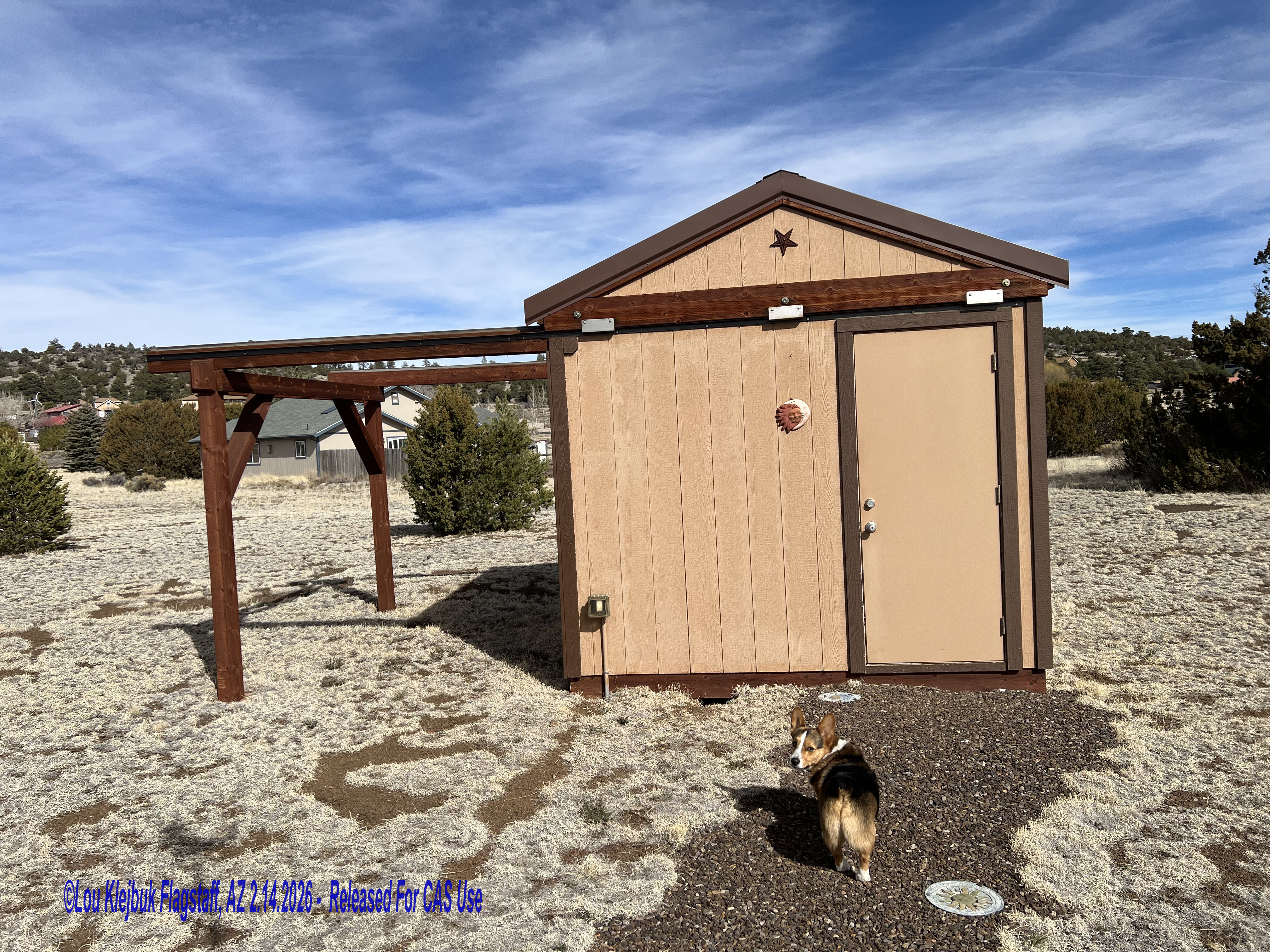
La Mancha Observatory |
The La Mancha Roll-Off House Observatory is located approximately 5 miles east of downtown Flagstaff at 6500 ft elevation. Light pollution is Bortle 4.2. The 9.5 by 9.5 ft observatory was built by Backyard Observatories of Lodi, Ohio in 2019. The roof sits on six steel bearings and slides onto the outriggers by an electric rack-and-pinon motor. Lou Klejbuk |
|
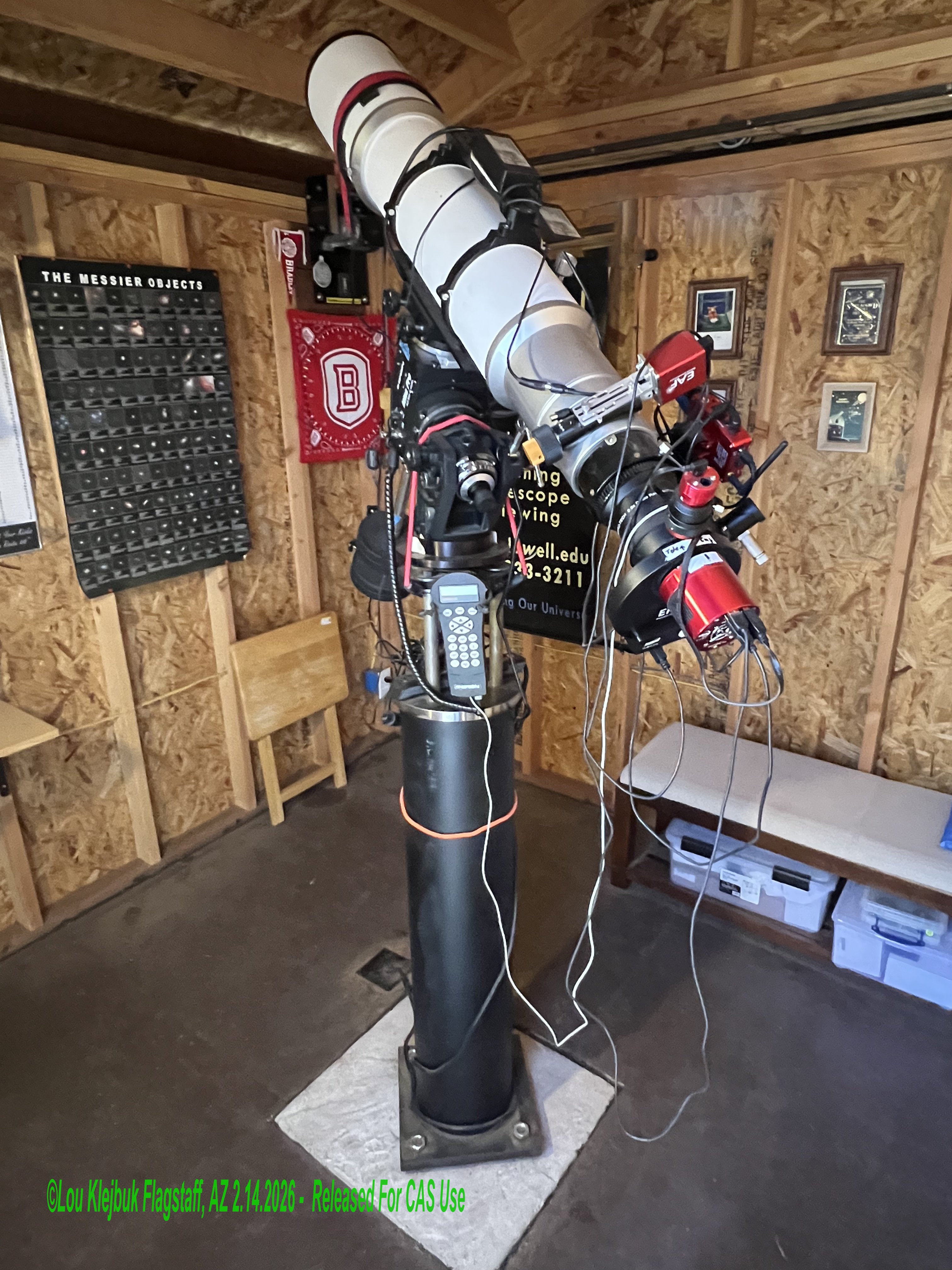
Astro-Tech Refractor |
The Astro-Tech refractor sits on an Orion Atlas Pro AZ/EQ-G GoTo Mount. The telescope and mount are firmly attached to an A53B Schedule 40 carbon steel pipe, and the pipe is bolted to a flared concrete footing that extends three feet below grade. The footing is isolated from the wood floor to minimize vibration. A power outlet, located next to the footing, eliminates a trip hazard. Lou Klejbuk |
|
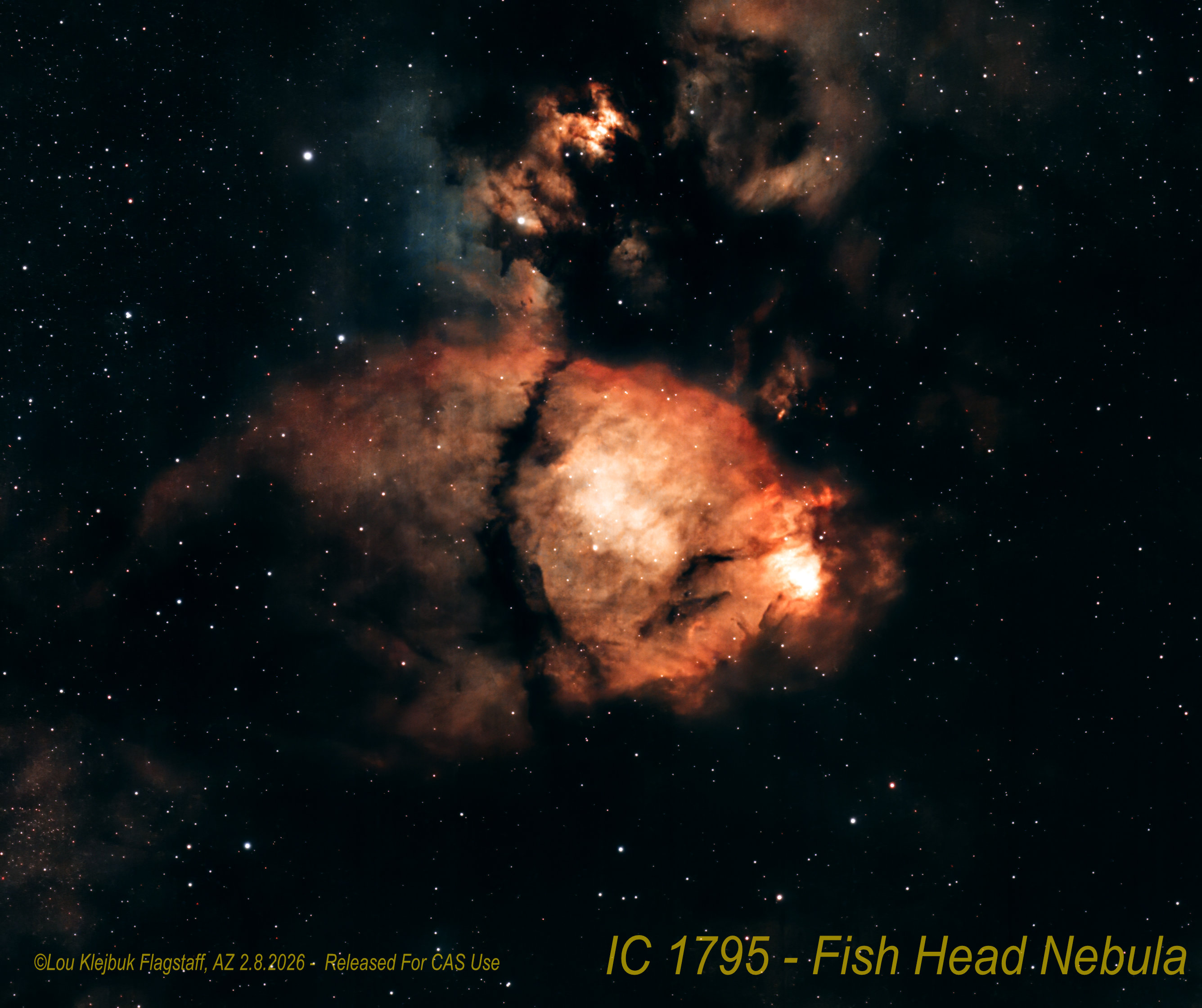
Fish Head Nebula (IC 1795) © 2026 Lou Klejbuk |
IC 1795, often called the Fish Head Nebula, is located 6,000 light-years away in the constellation Cassiopeia. IC 1795, also designated as NGC 896, forms the “bottom” of the large emission nebula, IC1805, The Heart Nebula. The image was built from 202 30-second exposures through an Optolong L-eNhance light pollution filter that transmits key nebulous wavelengths: Hydrogen-Alpha, Hydrogen-Beta and Oxygen-III. Calibration frames were also applied. Lou Klejbuk |
|
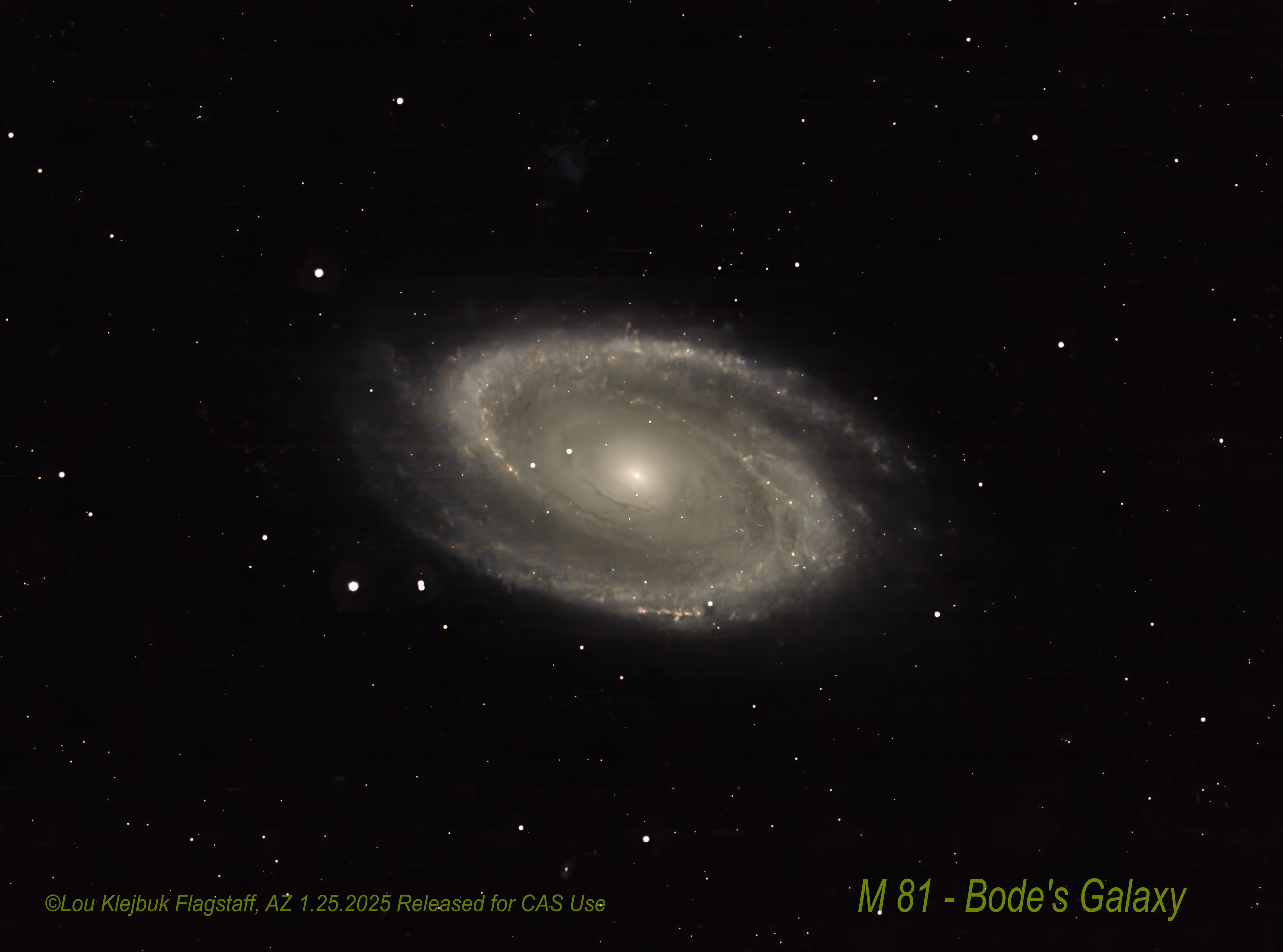
Spiral Galaxy (M-81) © 2026 Lou Klejbuk |
Discovered by Johann Elert Bode in 1774, this magnitude 6.8 spiral galaxy in Ursa Major is referred to as “Bode’s Nebula” or “Bode’s Galaxy.” It was added to the Messier List (#81) in 1781. The galaxy is estimated to be 12 million light-years away and its mas is calculated to be around 250 billion suns. Well over a third of the mass appears to be concentrated in the amorphous central hub and therefore the light from the stars in the hub gives M81 a somewhat yellow hue. The image was built from 200 30-second exposures through an Optolong L-eNhance light pollution filter that transmits wavelengths of Hydrogen-Alpha, Hydrogen-Beta and Oxygen-III. Calibration frames were also applied. Lou Klejbuk |
|
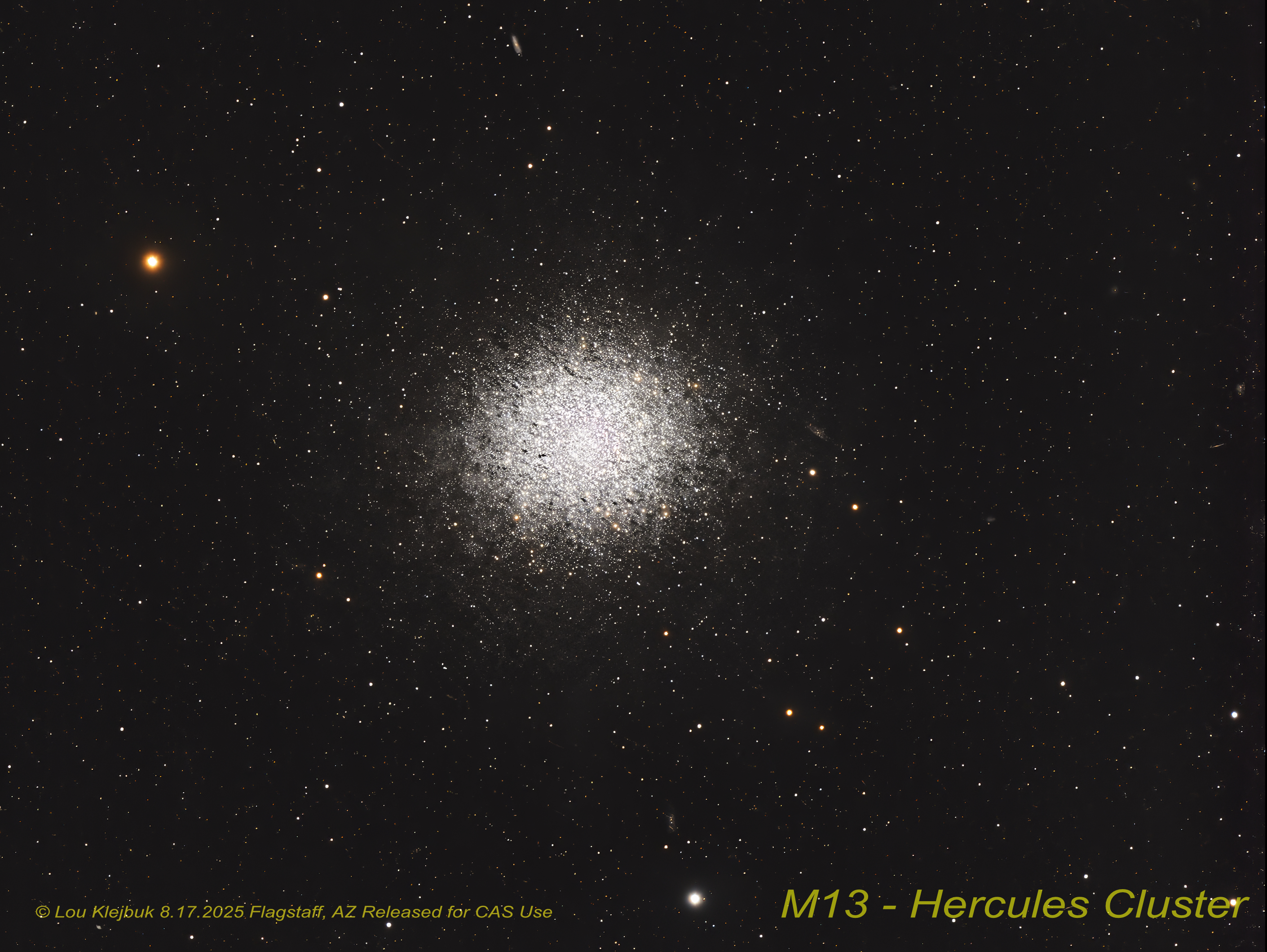
Great Hercules Cluster (M-13) © 2026 Lou Klejbuk |
Discovered by Edmond Halley in 1714, this magnitude 5.8 globular cluster in the constellation Hercules is barely visible to the naked eye on very dark nights but easily visible with binoculars. It was added to the Messier List (#13) in 1764. The galaxy is estimated to be only 25,100 light-years away and the number of stars in M13 is estimated to be several hundred thousand to more than one million. Globular cluster are ancient systems, and M-13 is estimated to 12 billion years old. The image was built from 191 30-second exposures through an IR-Cut Filter that sharpens the image. Calibration frames were also applied. Lou Klejbuk |
|
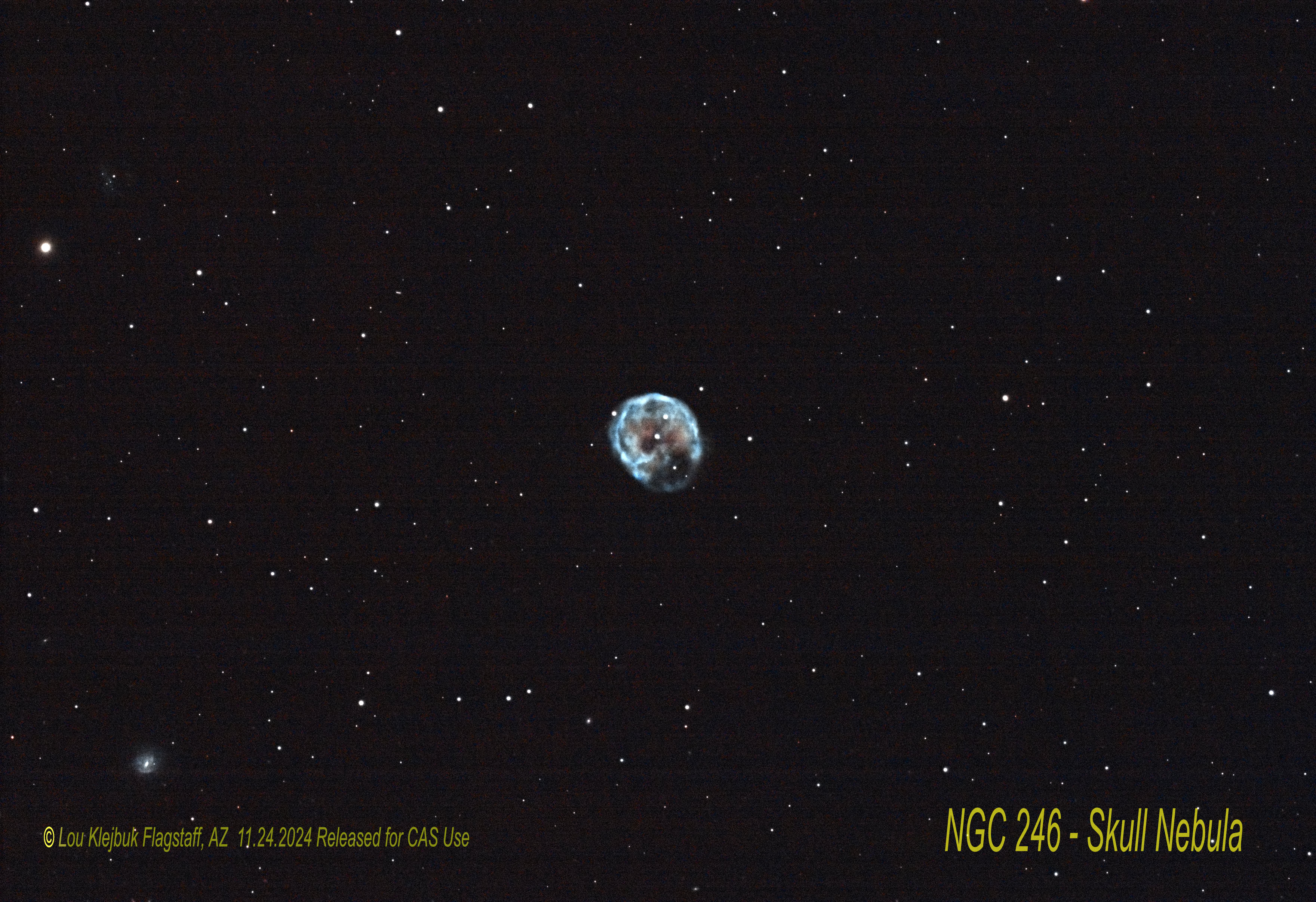
Skull Nebula (NGC 246) © 2026 Lou Klejbuk |
Discovered by William Herschel in 1785, this magnitude 10.4 planetary nebula 1800 light-years away in the constellation Cetus. The name, planetary nebulae, was initially used because the image resembled a planetary disk. However, we now know that planetary nebulae are gas clouds that are ionized and/or compressed by a compact hot stellar core that remains in the center of the cloud. The image was built from 120 30-second exposures through an Optolong L-eNhance light pollution filter that transmits key planetary nebulae wavelengths: Hydrogen-Alpha, Hydrogen-Beta and Oxygen-III. Calibration frames were also applied. Lou Klejbuk |